


In their recent study published in Oncotarget Shimabukuro-Vornhagen and colleagues present interesting data on tumor-associated B cell subsets in patients with colorectal cancer [1]. The authors noted a significantly higher frequency of CD27+IgD− B cells in the peripheral blood of such patients as compared to healthy subjects. The results were interpreted as a specific B cell immune response against the tumor, resulting in the accumulation of terminally differentiated memory B cells or plasma cells. Since the phenotype of B cells may not be sufficient to safely predict their function, we would like to suggest an alternative explanation for the occurrence of CD27+IgD− B cells in these patients.
In a recent study, we screened the tumor microenvironment of various tumors for a novel regulatory B cell subset characterized by unique expression of the serine protease granzyme B (GrB) and potent GrBdependent T cell-suppressive activity [2]. We found that several tumor entities including colorectal, mamma, cervical and ovarian carcinomas contain significant numbers of GrB-expressing regulatory B cells. Notably, further phenotypic characterization of this GrB+ regulatory B cell subset showed enhanced expression of CD27, CD38, IgM, CD1d, CD86 and CD147. In contrast, expression of IgD and CD24 was downmodulated or unaltered in this novel regulatory B cell subset. The phenotype of GrB+ regulatory B cells is therefore in part similar to that of terminally differentiated plasma cells, a finding also reported by several independent groups working on distinct regulatory B cell subsets such as IL- 10-secreting regulatory B cells [3, 4].
The reason for this phenotypic similarity between regulatory B cells and plasma cells may be that both B cell populations share a key cytokine for their development, namely interleukin 21 (IL-21) [2, 5-7]. As previously shown by our group it depends on a second T cell-derived stimulus, CD40 ligand (CD40L), whether IL-21 drives B cells to differentiate into GrB-secreting regulatory B cells (in the absence of CD40L), or into antibody-secreting plasma cells (in the presence of CD40L) (Figure 1) [8, 9].
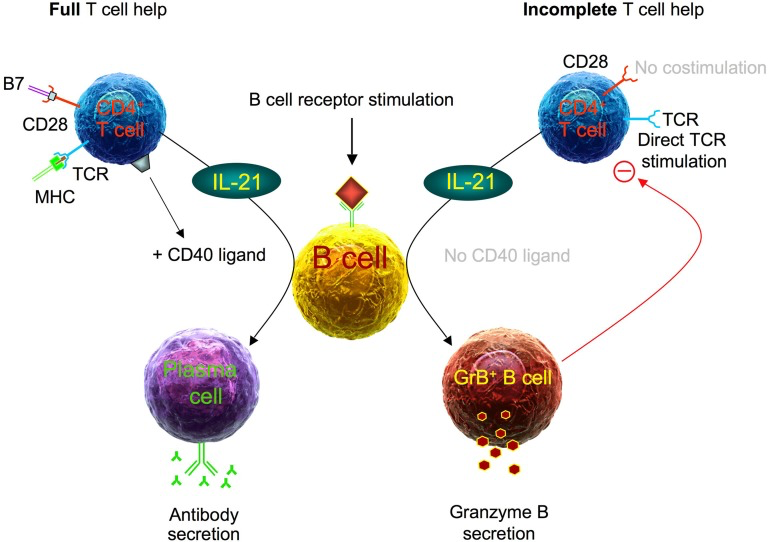
Figure 1. B cell differentiation in the presence of full T cell help as compared to incomplete T cell help Normal CD4+ T cell activation includes stimulation of both the TCR via MHC/peptide complexes and CD28 via B7 (left panel side). Such fully activated T cells secrete IL-21 and express high levels of CD40L, enabling them to induce plasma cell differentiation in B cells, which receive antigenspecific signals via their BCR at the same time. In contrast, early during viral infections and during malignant transformation the TCR of CD4+ T cells is often unspecifically stimulated via MHC-antigen complexes without simultaneous co-stimulation of CD28 (right panel side). Such incompletely activated T cells secrete IL-21, but barely express CD40L, resulting in the induction of GrB+ regulatory B cells.
Meanwhile it is widely accepted that B cells exhibit a broad spectrum of functions beyond antibody secretion including T cell regulation, antigen presentation, cytokine production and direct cytotoxicity. Functional assays accompanying the phenotypic characterization of B cell populations may therefore avoid conflicting results on distinct functions of certain B cell subsets, particularly in an aberrant microenvironment such as in the presence of tumors.
References
- 1. Shimabukuro-Vornhagen A, et al. Oncotarget.2014;5:4651-4664. [PubMed] https://doi.org/10.18632/oncotarget.1701
- 2. Lindner S, et al. Cancer Res.2013;73:2468-2479. [PubMed] https://doi.org/10.1158/0008-5472.CAN-12-3450
- 3. Blair PA, et al. Immunity.2010;32:129-140. [PubMed] https://doi.org/10.1016/j.immuni.2009.11.009
- 4. Sumimoto K, et al. Pancreatology.2014;14:193-200. [PubMed] https://doi.org/10.1016/j.pan.2014.02.004
- 5. Yoshizaki A, et al. Nature.2012;491:264-268. [PubMed] https://doi.org/10.1038/nature11501
- 6. Ettinger R, et al. J Immunol.2005;175:7867-7879. [PubMed] https://doi.org/10.4049/jimmunol.175.12.7867
- 7. Ozaki K, et al. J Immunol.2004;173:5361-5371. [PubMed] https://doi.org/10.4049/jimmunol.173.9.5361
- 8. Hagn M and Jahrsdorfer B. Oncoimmunology.2012;1:1368-1375. [PubMed] https://doi.org/10.4161/onci.22354
- 9. Hagn M, et al. Immunol Cell Biol.2012;90:457-467. [PubMed] https://doi.org/10.1038/icb.2011.64